An alternative approach to building a simple API Rate limiter using NodeJS and Redis
Recently I came across an interesting problem of building an API rate limiter. While doing a bit of research on the same, I came across various algorithms and approaches. Some of the popular algorithms used to implement rate limiting are:
- Token bucket
- Leaky bucket
- Fixed window counter
- Sliding window log
- Sliding window counter
This post is NOT about these algorithms. I will try and explain an alternative approach here which makes use of certain Redis specific features.
Design/Algorithm
High level system setup:
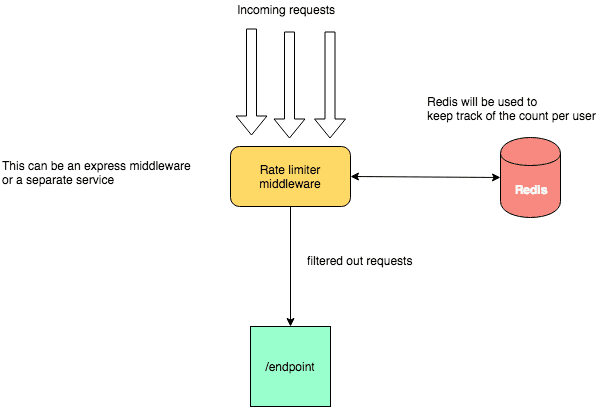
Lets say we have some way of uniquely identifying the source of each request. This can be the ip address, API key, user token or even user name.
For this example lets assume this unique identifier is a user token and we want to set a rate limit of 20 requests per min for the user. Now for each user we maintain one key in our redis store.
Basic idea is whenever we receive a request:
We extract the unique id (user_token) that helps us identify the user. Lets say
user_token="abcdefghijklmno"Start a transaction to our redis store.
Set a redis key with value 0 if it doesnt exist already and expiry as 60sec
SET abcdefghijklmno 0 EX 60 NX
This will allow us to set the key to 0 if it doesnt exist and auto expire/clean the key after 60 secs. Note this doesnt alter the key if it already exists.
- Increment the value of the key
INCR abcdefghijklmno
Execute the transaction. By doing these two operations in a transaction we do this atomically and hence are safe from race conditions.
In the result of the transaction we will get the current value of
abcdefghijklmnowhich is the total requests made by the user within 60sec. If this value is greater than the threshold (in our case 20) we reject the request.
TLDR;
Redis commands:
> MULTI
OK
> SET <user_token> 0 EX 60 NX
QUEUED
> INCR <user_token>
QUEUED
> EXEC
1) OK
2) (integer) 1
If the value of the integer in the last result is greater than 20 we reject the request.
Show me some code
Lets take the case of a simple express server:
const app = express()
app.post('/login', loginHandler)
app.get('/ping', pingHandler)
app.get('/api-1', api1Handler)
app.post('/api-2', api2Handler)
app.get('/api-3', api3Handler)
To rate limit /api-1, /api-2 and /api-3 to 20 requests per min, create an express middleware: rateLimiter.js
const rateLimiter = (req, res, next) => {
  return next()
}

module.exports = { rateLimiter }
And add it before the endpoints to be rate limited:
const { rateLimiter } = require('./rateLimiter')

const app = express()
app.post('/login', loginHandler)
app.get('/ping', pingHandler)
app.use(rateLimiter) // middleware to limit requests to api-1, api-2, api-3
app.get('/api-1', api1Handler)
app.post('/api-2', api2Handler)
app.get('/api-3', api3Handler)
Now modify rateLimiter.js with the actual logic:
const redis = require('redis')

const client = redis.createClient(process.env.REDIS_URL)

client.on('error', err => console.log(`Error ${err}`))

const rateLimiter = (req, res, next) => {
  const token = req.user.token // unique identifier - can be ip, API_KEY, etc
  client
    .multi() // start a transaction
    .set([token, 0, 'EX', 60, 'NX']) // SET UUID 0 EX 60 NX
    .incr(token) // INCR UUID
    .exec((err, replies) => {
      if (err) {
        return res.status(500).send(err.message)
      }
      const reqCount = replies[1]
      if (reqCount > 20) {
        return res
          .status(403)
          .send(`Quota of ${20} per ${60}sec exceeded`)
      }
      return next()
    })
}

module.exports = { rateLimiter }
In ~20 lines of code we have our very own simple and performant rate limiter.